2026-10-03
Consult a Board-Certified Dermatologist Before Deciding on Apgujeong Thread Lifting
Explains how thread lifting works, thread types, ideal candidates, the most satisfying treatment areas, side effects, how long results last, and aftercare tips.
Consult a board-certified dermatologist before deciding on Apgujeong thread lifting

Hello, this is DM Dermatology Clinic. Thread lifting is one of the most effective lifting procedures, capable of delivering results comparable to surgery without actually undergoing surgery. Those who have tried it will likely agree. Its results are highly distinctive and truly one of a kind.
Recently, petit cosmetic procedures that create dramatic, surgery-like changes without surgery have become popular at dermatology clinics, and thread lifting is the most frequently requested among them. Many people have questions about pain, how long results last, suitable ages, and side effects. In this post, we will answer these questions.
How Thread Lifting Works and Its Benefits
Thread lifting involves inserting special threads under the skin to pull tissue and stimulate the production of collagen and elastin. Without any incisions, it can quickly and safely provide facial lifting, facial contour correction, and improved skin firmness, which is why patients are very satisfied with it.
Types and Characteristics of Threads
Threads differ depending on their raw materials. PDO and PCL are the most commonly used. Thanks to advances in thread manufacturing technology, the performance of threads (lifting strength, biocompatibility, and durability) has improved significantly, so effective results can be expected regardless of the type of thread used.
At our Apgujeong dermatology clinic, we use Mint threads and Blue Rose threads, both of which have received FDA approval in the United States. These two types of threads offer excellent lifting strength, long-lasting results, and the ability to create the desired shape.
Who Is a Good Candidate for Thread Lifting, and Who Is Not?
Thread lifting is designed to lift sagging skin, but its effects may be limited if skin elasticity has declined too much. Instead, it works well for correcting double chins and nasolabial folds in people in their 30s and 40s. For older patients whose skin elasticity has declined, combining it with other procedures can produce better results.
Results may be somewhat reduced if there is excessive subcutaneous fat that makes the skin feel heavy or stiff, or if there is little soft tissue and the skin lies directly over the facial bone. In such cases, combining other treatments first, or considering thread lifting after increasing skin thickness with fillers, can lead to higher satisfaction.
Areas with the Highest Satisfaction
The area where thread lifting yields the highest patient satisfaction is the sagging jowl area (deep cheek). With age, the deep cheek area descends and becomes more prominent, and among procedures that lift this area, thread lifting shows the most outstanding results.
The second most satisfying area is the nasolabial fold. Even nasolabial folds that are difficult to address with fillers or other methods can be actively improved with Apgujeong thread lifting, and patient satisfaction is also very high. It is also effective for brow lifts to raise drooping eyebrows and for eye-area correction.
Side Effects and How to Manage Them
Common side effects may include asymmetry, thread visibility, and skin dimpling (indentation). Asymmetry can be corrected with an additional procedure, thread visibility can be concealed with fillers, and dimpling can be corrected immediately with massage.
All threads currently in use are skin-friendly and made of materials that dissolve in the body, so these side effects fully resolve over time.
How Long Results Last and How to Maintain Them
The duration of thread lifting results varies depending on the type and amount of thread used and the patient's skin condition. Jawline and cheek lifting tend to last relatively long, while areas directly under the eyes or the nasolabial folds are influenced by muscle movement, so results may last a bit shorter.
The most reliable way to make results last longer is to repeat the procedure several times. For example, you can have another session before the effects fully fade, and then another after that. Repeating it three to four times over two years can create a noticeable difference in your facial appearance before and after treatment. In addition, the more threads used, the longer the results tend to last.
The ideal timing for re-treatment depends on each person's skin condition and satisfaction level. Based on how long the thread material typically remains effective, re-treatment is generally appropriate at 6–9 months for PDO threads and 9 months to 1 year for PCL threads.
Precautions for Thread Lifting and Advice from Specialists
For two weeks after the procedure, avoid applying strong pressure or massage to the treated area. During these first two weeks, before the threads have settled in place, it is also best to avoid intense exercise, saunas, jjimjilbang (Korean heated bathhouses), alcohol, and smoking.
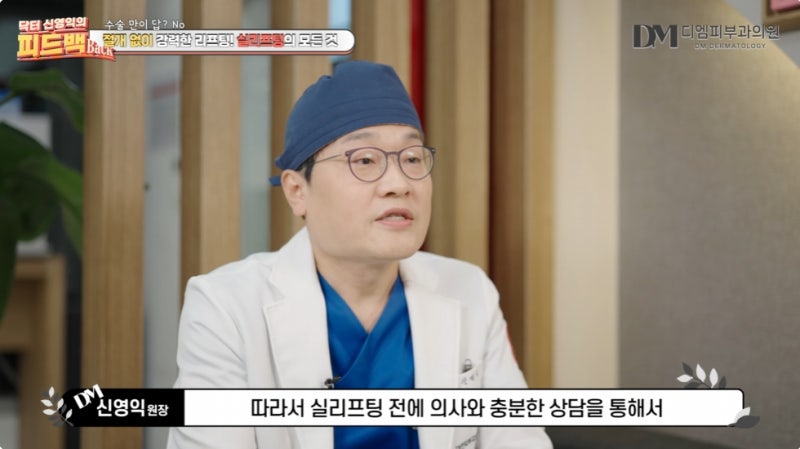
Apgujeong thread lifting is a procedure in which the doctor's experience and aesthetic design are extremely important. The more experienced the dermatologist, the higher the satisfaction, so you should thoroughly consult with your doctor before the procedure, discussing both the areas you want to address and those the doctor recommends, in order to feel satisfied with the results.












Frequently Asked Questions
Which area has the highest satisfaction rate for thread lifting?
Deep cheek lifting for sagging jowls has the highest satisfaction rate. Thread lifting shows outstanding results in improving the deep cheek area, which sags and enlarges with age, and nasolabial folds and brow lifts also have high satisfaction rates.
How often should thread lifting be repeated?
Depending on the type of thread, re-treatment is generally appropriate every 6–9 months for PDO threads and every 9 months to 1 year for PCL threads. Repeating the procedure three to four times over two years, before the effects have fully faded, can help you maintain satisfying results for longer.
What should I do if dimpling or asymmetry occurs after thread lifting?
Dimpling can be corrected immediately with massage, and asymmetry can be improved with an additional procedure. Because the threads are skin-friendly and dissolve in the body, related side effects naturally resolve over time.
What should I be careful about after thread lifting?
For two weeks after the procedure, avoid applying strong pressure or massage to the treated area. Until the threads have fully settled, it is safest to avoid intense exercise, sauna and jjimjilbang use, alcohol, and smoking.
Are there skin types that may see reduced results from thread lifting?
Yes. Skin with excessive subcutaneous fat that feels heavy, or conversely, skin with very little soft tissue, may see somewhat reduced results. In such cases, it is recommended to supplement skin thickness with filler or other treatments before undergoing thread lifting.